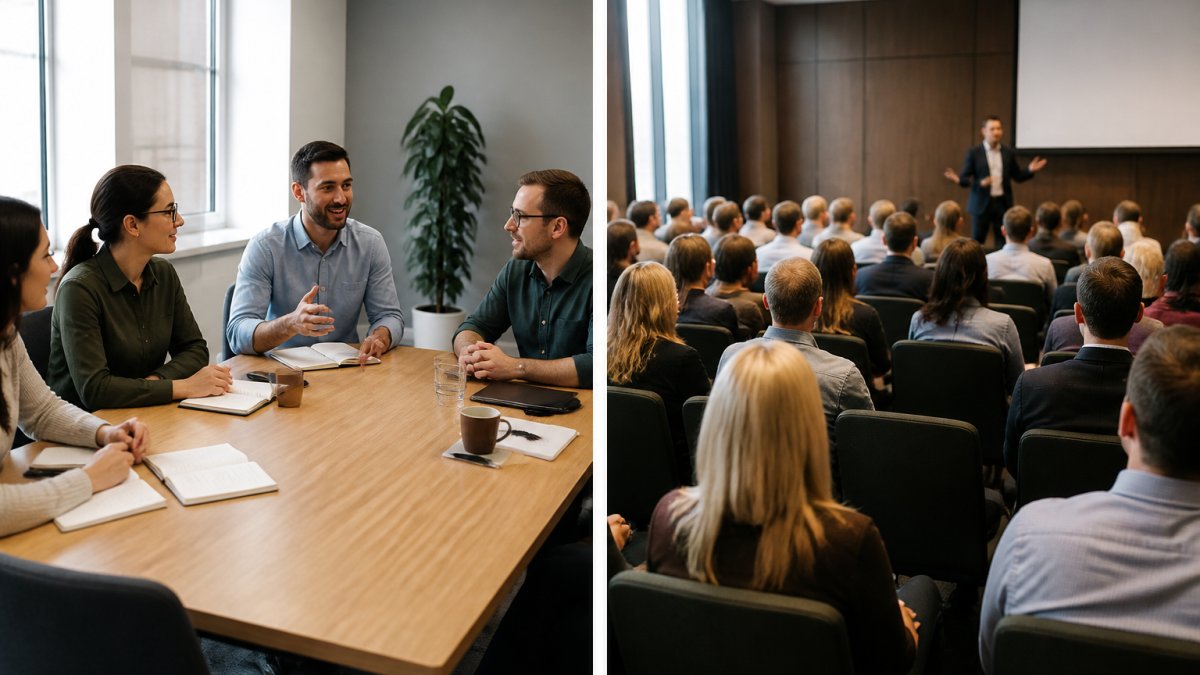
 comparison
Cost of Professional Conflict Resolution Training
Table of Contents
- What Determines the Cost of Professional Conflict Resolution Training?
- Online Conflict Resolution Training: Costs and Trade-Offs
- How Conflict Resolution Training Duration Affects Your Budget
- Conflict Resolution Training for Managers: Why It Costs More Than You Think
- Bespoke Conflict Resolution Training: When Tailoring Pays Off
- How to Budget for Conflict Resolution Training in 2026
- Frequently Asked Questions
Last Updated: 15 October 2026
What Determines the Cost of Professional Conflict Resolution Training?
The cost of professional conflict resolution training depends on four things: delivery format, group size, programme length and how far the content is tailored to your organisation. There is no single market rate, and any provider quoting one flat figure is guessing about your context.
At MacMillan Training Partnership, we price bespoke work by scope rather than by seat, because a half-day session for eight supervisors and a two-day programme for sixty staff are different products entirely. The variables that move the number most are the ones below.

Delivery Format: In-House, Open Course or Online
In-house training costs more per day but less per person. You pay for the trainer's time, not for each delegate's place, so the per-head figure falls sharply as group size rises.
Open courses flip that logic. You buy individual seats on a scheduled date, which suits one or two people but becomes expensive once you are booking a whole management tier.
Online delivery sits between the two. Live virtual classrooms cut travel and venue costs, while self-paced modules cut them further still. What you lose is the room itself: difficult conversations are easier to rehearse when everyone is physically present.
Group Size, Duration and Customisation
Three levers control most of the budget:
- Group size. In-house rates are usually quoted per day, so a group of twenty costs roughly the same as a group of twelve.
- Duration. A half-day awareness session and a two-day skills programme are not comparable purchases.
- Customisation. Off-the-shelf material is cheapest. Sector-specific scenarios, your own policies and pre-course consultation all add design time.
Online Conflict Resolution Training: Costs and Trade-Offs
Online conflict resolution training is the cheapest entry point, but the price gap between self-paced modules and live virtual classrooms is wider than most buyers expect. A short self-paced class can cost a fraction of a facilitated virtual programme, and the difference shows up in what delegates actually retain.
Self-paced works well for background knowledge. It works badly for practising a heated conversation, because there is nobody to react to you.
Live virtual sessions keep the facilitator and the group, which preserves role-play and feedback. They cost more than recorded content and less than bringing a trainer on site.
The honest trade-off is this: online delivery saves money and travel time, and it asks more of the learner. Anyone who does not block the time will not finish the course.
How Conflict Resolution Training Duration Affects Your Budget
Conflict resolution training duration is the single clearest driver of price, because you are buying facilitator days. Doubling the length roughly doubles the cost, whether the programme runs in-house or online.
Most providers structure it in three tiers:
| Format | Typical Duration | What It Covers | Best For |
|---|---|---|---|
| Awareness session | Half day | Recognising conflict styles, escalation signals | Whole teams, large groups |
| Skills workshop | One day | Difficult conversations, mediation basics, practice | Line managers, supervisors |
| Full programme | Two days or more | Mediation, investigation, policy, assessment | HR staff, senior managers |
Shorter is not automatically better value. A half-day that leaves people able to name their conflict style but unable to hold the conversation has bought you vocabulary, not capability.
Conflict Resolution Training for Managers: Why It Costs More Than You Think
Conflict resolution training for managers costs more than general staff training because the content is harder to deliver and the stakes are higher. Managers need practice in live mediation, not a lecture on conflict styles.
A supervisor who mishandles a grievance can turn a fixable disagreement into a formal process. That is why the good programmes include assessed role-play, feedback and follow-up, and why they take longer than an afternoon.
There is a second cost that rarely appears in the quote. Managers pulled out of rotas for two days cost you their output, and backfilling them costs more still. Factor that in before comparing providers on fee alone.
The Advisory, Conciliation and Arbitration Service guidance on workplace mediation sets out how mediation fits alongside formal procedures. Training that ignores your existing grievance process creates confusion rather than resolution.
Bespoke Conflict Resolution Training: When Tailoring Pays Off
Bespoke conflict resolution training pays off when your sector has its own vocabulary, its own escalation routes and its own regulatory backdrop. Generic case studies about office politics land badly with clinical teams, caseworkers or site crews.
Tailoring typically covers three things:
- Scenarios drawn from your actual incidents, anonymised
- Your policies, procedure names and reporting lines
- The specific relationship dynamics between the groups in the room
The cost sits in design time, not delivery. A provider needs to interview stakeholders, read your policies and write new material. That is a real cost, and it is also what makes the training stick.
Where tailoring does not pay off is a one-off session for a small group with no unusual context. Buy an open course instead.
How to Budget for Conflict Resolution Training in 2026
Budgeting starts with the outcome you need, not the price list. Decide whether you are buying awareness, manager capability or formal mediation skill, then price the format that delivers it.
A workable sequence:
- Count the people who genuinely need it. Training the whole organisation at awareness level and managers at skills level is usually more effective than one blanket programme.
- Choose the format per group. In-house for cohorts above roughly ten, open courses for smaller numbers.
- Get quotes against a written brief. Include group size, duration, sector and whether you need tailored scenarios.
- Ask about early booking terms. Booking well ahead can reduce the fee, so check what lead time the provider needs.
- Add the hidden costs. Venue, travel, backfill and lost output belong in the same spreadsheet as the course fee.
MacMillan Training Partnership runs open courses and in-house programmes in physical and virtual classrooms, with an Early Bird discount of up to £100 for bookings made more than eight weeks in advance. That lead time matters when you are planning a financial year.
For the current fee for your programme, check the MacMillan Training Partnership course listings or request a quote against your brief. CIPD members can also draw on CIPD resources on managing conflict at work when building the business case.
Frequently Asked Questions
How much does professional conflict resolution training cost?
There is no single price for conflict resolution training. Costs depend on delivery format, group size, duration and how much tailoring you need. Open courses are usually priced per person, while in-house programmes are quoted for the whole group. Some providers offer early booking discounts, such as up to £100 off for bookings made more than eight weeks in advance. Request a quote based on your team's specific needs to get an accurate figure.
Is online conflict resolution training cheaper than in-person training?
Online conflict resolution training often costs less than in-person delivery because there are no venue, travel or catering expenses. However, the price difference depends on the provider and the level of interaction included. Weigh the lower price against how much live practice and discussion your team needs to embed the skills.
How long does conflict resolution training usually take?
Conflict resolution training duration varies widely. In-house workshops typically last one or two days. The duration affects the total cost because longer programmes require more trainer time and may include assessment or follow-up sessions. Match the length to the depth of skill your managers need.
Can conflict resolution training be tailored to our organisation?
Yes. Bespoke conflict resolution training is built around your sector, team structure and the specific conflict scenarios you face. Tailoring adds to the cost because the provider spends time on discovery, design and custom materials. The payoff is higher relevance and better retention. Ask providers how they gather information about your culture and systems, and whether they offer separate programmes for different staff groups, such as clinicians and administrative teams.
Conflict is expensive whether you train for it or not, and the untrained version shows up as turnover, sickness absence and formal grievances. MacMillan Training Partnership delivers tailored leadership and behavioural programmes across the UK and Northern Ireland, available in physical and virtual classrooms, with hundreds of live events and in-house courses to choose from. Get started with MacMillan Training Partnership and build the manager capability that keeps small disagreements small.