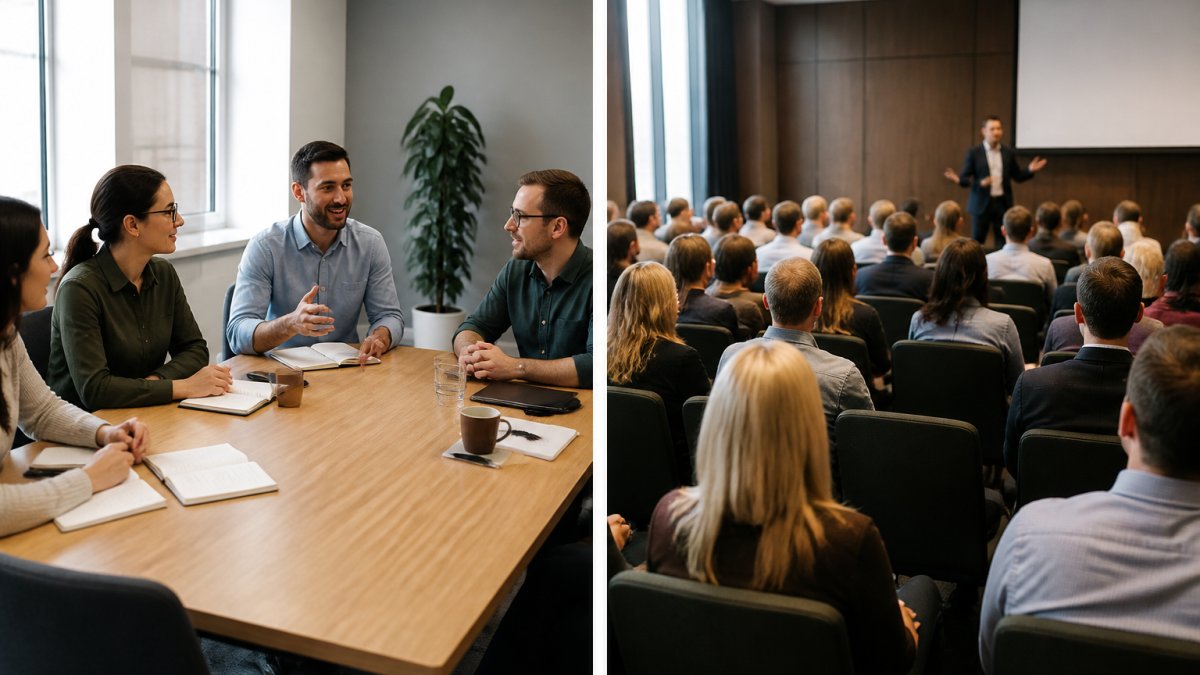
 comparison
Leadership Coaching vs Training for Managers
Table of Contents
- Leadership Coaching vs Training for Managers: Key Differences
- What Leadership Coaching Offers Managers
- What Manager Training Topics Cover
- Manager Development Plan Examples and Implementation
- How to Measure Leadership Development Outcomes
- Can Coaching and Training Work Together?
- Choosing Between Coaching and Training for Your Team
- Frequently Asked Questions
Last Updated: 9 October 2026
Leadership Coaching vs Training for Managers: Key Differences
Leadership coaching and training serve different purposes in developing managers, and understanding which approach fits your organisation's needs is crucial. Coaching is a one-to-one, ongoing relationship where a professional coach helps a manager identify goals, overcome obstacles, and build capabilities through personalised dialogue. Training, by contrast, is typically group-based, structured instruction focused on teaching specific skills or knowledge to multiple participants in a defined timeframe.
The distinction matters because they address different development needs. Training works well when you need to build a common skillset across your team, how to run effective meetings, handle difficult conversations, or use new systems. Coaching excels when a manager faces unique challenges or needs tailored support to unlock their full potential.

At MacMillan Training Partnership, we work with organisations across the UK and Northern Ireland that often grapple with this exact question. The reality is that many successful development strategies use both, but knowing when to deploy each makes the difference between transformational change and wasted budget.
| Aspect | Coaching | Training |
|---|---|---|
| Format | One-to-one, ongoing | Group-based, scheduled |
| Duration | Typically 3-12 months | Usually 1-5 days |
| Focus | Individual goals and challenges | Common skills and knowledge |
| Personalisation | Highly tailored to the person | Standardised content with customisation options |
| Cost per person | Higher upfront investment | Lower per-participant cost |
| Best for | Senior managers, high-potential talent | Building team-wide capability |
What Leadership Coaching Offers Managers
Coaching provides a confidential space for a manager to explore their challenges with a trained professional who isn't invested in the organisation's politics. This neutrality is powerful. A manager can discuss struggles with delegation, confidence gaps, or relationship tensions without worrying about career implications.
The coaching process typically involves regular sessions, often monthly or fortnightly, where a coach helps the manager clarify what they want to achieve, identify patterns that hold them back, and test new approaches. This iterative, reflective work builds self-awareness and sustainable behaviour change. A manager doesn't just learn a technique; they develop the insight to know when and how to apply it.
Coaching also addresses the reality that every manager's situation is different. A newly promoted manager might need support navigating their first team, whilst an experienced leader might struggle with stakeholder management or strategic thinking. A coach tailors the conversation to what that individual actually needs, rather than delivering a one-size-fits-all curriculum.
The downside is cost and time. Quality coaching isn't cheap, and it demands consistent commitment from the manager. If your organisation needs to shift behaviour across 50 managers quickly, coaching alone won't be practical.
What Manager Training Topics Cover
Training programmes typically address skills that benefit most managers regardless of context. Common topics include:
- Effective communication and difficult conversations - how to deliver feedback, handle conflict, and have candid discussions
- Delegation and team management - building trust, assigning work effectively, and developing your team
- Performance management - setting clear expectations, reviewing progress, and managing underperformance
- Emotional intelligence - recognising emotions in yourself and others, and using that awareness to lead better
- Strategic thinking and business acumen - understanding how your team fits into the broader organisation
- Change management - helping your team navigate transitions and maintain morale
Training works because it creates a shared language and common understanding. When your whole management team learns the same framework for giving feedback or handling conflict, they can reinforce each other's learning and apply it consistently across the organisation.
MacMillan Training Partnership delivers these topics in both open courses, where managers from different organisations learn together, and tailored in-house programmes designed specifically for your culture and challenges. The tailored approach means you're not just teaching generic skills; you're showing how they apply to your actual environment, your systems, and your team dynamics.
The limitation of training alone is that knowing a technique and actually using it under pressure are different things. A manager might leave a training course energised, then slip back into old habits within weeks when they're busy or stressed.
Manager Development Plan Examples and Implementation
A manager development plan typically outlines what a manager needs to develop, how they'll develop it, and how progress will be measured. Here's what a practical plan looks like:
Example 1: New Manager Foundation
- Objective: Build confidence and capability in first-time management
- Activities: Attend training on delegation and performance management; monthly coaching sessions to discuss real team challenges
- Timeline: 6 months
- Success measures: Team feedback improves; manager feels confident handling difficult conversations
Example 2: Senior Manager Acceleration
- Objective: Develop strategic leadership and stakeholder influence
- Activities: Tailored coaching on executive presence; attendance at advanced leadership training on business strategy
- Timeline: 9 months
- Success measures: Visible influence on strategic decisions; improved relationships with peers and senior leaders
Example 3: Targeted Skill Development
- Objective: Improve team retention and engagement
- Activities: Training on emotional intelligence and team development; peer learning group to share approaches
- Timeline: 3 months
- Success measures: Staff turnover decreases; engagement survey scores improve
Implementation works best when you're clear about the starting point. What does the manager struggle with? What feedback have they received? What's holding back their performance? A good development plan isn't generic; it's built on honest assessment of where they are and where they need to go.
How to Measure Leadership Development Outcomes
Measuring development impact is notoriously difficult, but it's essential if you want to know whether your investment is working. Here's what to track:
Behavioural change - Ask the manager's team whether they've noticed changes. Are they receiving clearer feedback? Do conversations feel more open? This is often the most telling measure because it reflects whether learning has translated into action.
Business metrics - Look at outcomes that matter to your organisation. Has team turnover decreased? Are projects finishing on time? Has customer satisfaction improved? These aren't always direct measures of the manager's development, but they reflect whether better management is having an impact.
Manager confidence and capability - Ask the manager themselves. Do they feel more confident in their role? Can they identify specific situations where they've handled things differently? This self-assessment matters because confidence often precedes sustained behaviour change.
Engagement and retention - Teams with better-developed managers tend to stay longer and report higher engagement. Track whether your development investment is reducing turnover or improving survey scores.
The practical challenge is that development outcomes take time to show. A manager might shift their approach immediately, but it takes months for their team to fully trust the change or for business metrics to reflect it. Patience and consistent measurement matter more than looking for quick wins.
Can Coaching and Training Work Together?
The best approach often combines both. Training builds foundational skills and creates a shared language across your management team. Coaching then helps individual managers apply those skills to their unique situation and overcome the obstacles that prevent them from changing.
Here's a realistic sequence: your managers attend training on difficult conversations. They learn the framework and practise in a safe environment. Then, over the following months, a coach works with each manager to apply that framework to their actual relationships, the conversation they've been avoiding, the team member they struggle to connect with, the stakeholder relationship that's tense. The coach helps them navigate the real complexity that training alone can't address.
This combination works because training is efficient at scale, whilst coaching is efficient at depth. You're not paying coaching fees for every manager to learn basic skills they can pick up in a group setting. And you're not expecting training alone to shift deeply ingrained patterns or solve complex interpersonal challenges.
MacMillan Training Partnership supports this blended approach by offering both tailored training programmes and connections to coaching resources, so you can design a development strategy that matches your needs and budget.
Choosing Between Coaching and Training for Your Team
Start by asking what you're trying to achieve. If your goal is to build a common capability across your management team, everyone needs to improve their delegation skills, or your organisation is implementing a new performance management system, training is the right starting point. It's cost-effective and creates alignment.
If your goal is to develop specific high-potential managers, resolve a particular challenge with an individual leader, or provide ongoing support for someone in a critical role, coaching makes sense. The investment is higher, but the return is personalised and deep.
Consider your constraints. How much budget do you have? How much time can managers commit? Do you need results quickly, or can you invest in longer-term development? An organisation with tight budgets and urgent needs might start with targeted training. A larger organisation with capacity to invest in talent might use coaching for senior leaders and training for broader capability building.
Also think about your culture. Some organisations have a strong learning mindset where people actively seek development. Others need to build that culture first. Training can help shift mindset at scale; coaching deepens it for individuals who are already engaged.
The most common mistake is treating coaching and training as either-or choices. The organisations that see the strongest leadership improvement typically use both strategically, training for breadth, coaching for depth, tailored to the actual needs of their managers and their business.
Developing your managers is one of the highest-impact investments an organisation can make. Whether you choose coaching, training, or a combination of both, the key is clarity about what you're trying to achieve and commitment to measuring whether it's working. At MacMillan Training Partnership, we help organisations across the UK and Northern Ireland design development strategies that fit their culture, their budget, and their business priorities. Our tailored programmes and flexible delivery options, available in physical and virtual classrooms, mean you can build the approach that works for your team. Explore our leadership and management training courses to see how we can support your development goals. Subscribe to our updates for insights on building stronger leadership capability in your organisation.
Frequently Asked Questions
What is the difference between leadership coaching and training for managers?
Leadership coaching is a one-to-one or small-group process where a coach works with a manager on specific challenges, goals, and behaviours tailored to their role and organisation. Training for managers is typically group-based instruction on defined topics such as communication, delegation, or conflict resolution. Coaching is personalised and ongoing; training is structured and time-bound. Both can develop managers, but they address different needs and learning styles.
What are the main leadership coaching benefits for managers?
Coaching provides accountability, personalised feedback, and support for behaviour change in real-world situations. Managers benefit from confidential space to discuss challenges, access to expert guidance on their specific context, and faster progress on individual development goals. Coaching often leads to improved decision-making, stronger team relationships, and greater confidence in handling difficult situations.
How can organisations measure the impact of manager coaching and training?
Measure coaching through 360-degree feedback before and after, manager self-assessment on specific goals, team engagement surveys, and retention rates. For training, track knowledge retention through assessments, observe behaviour change on the job, and monitor team performance metrics. Both benefit from baseline metrics: set clear objectives before development begins, then review progress at 3, 6, and 12 months to show business impact.
Can leadership coaching and training be used together?
Yes, and many organisations find combining both most effective. Training provides foundational knowledge and skills across a team, whilst coaching reinforces learning through individual application and accountability. A manager might attend training on difficult conversations, then work with a coach to practise those skills in their specific team context. This blended approach accelerates behaviour change and increases retention of learning.